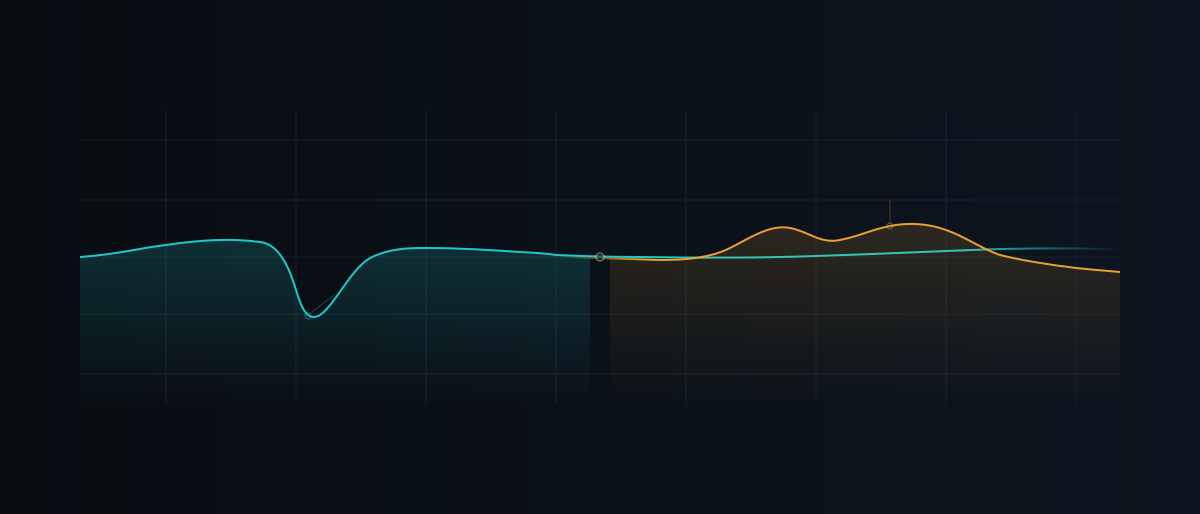
A producer records a vocal in an untreated bedroom, loads an automatic EQ plugin, and watches it carve out three room resonances in seconds. The result sounds noticeably cleaner. The next day, the same producer applies automatic EQ to a vocal sitting in a dense arrangement, and the result sounds worse: the algorithm "corrected" frequencies that were already working in context. Same tool, same producer, opposite outcomes. The difference was the type of problem, not the quality of the tool.
Automatic equalization is effective when the problem has a measurable target and a known correction path. It is unreliable when the solution depends on musical context that exists outside the analysed signal. The decision between automatic and manual EQ is a function of problem type, not skill level.
What automatic equalization actually does
Automatic equalization analyses the frequency content of an audio signal and applies corrective EQ curves based on a target profile, a reference track, or a trained model. The key distinction from manual EQ is where the parameter decisions happen. With manual EQ, the engineer selects every frequency, gain value, and bandwidth. With automatic EQ, the algorithm makes those selections based on its analysis of the signal.
This is analysis-driven processing, not random adjustment. The algorithm measures the signal, compares it against a reference or target, computes the difference, and applies corrections to close the gap. The quality of those corrections depends entirely on the quality of the comparison. If you are new to equalization as a concept, the foundational principle is the same: adjusting frequency balance to improve how a signal sounds. Automatic EQ automates the "how much" and "where" decisions that a manual approach would require the engineer to make.
How the three approaches work
Automatic EQ tools use one of three core methods, sometimes in combination. Understanding which method a tool uses matters because each has different strengths and limitations.
Spectral matching
Spectral matching compares the frequency spectrum of the input signal to a reference track and applies a corrective curve to close the difference between them. The algorithm performs a spectral analysis of both signals, computes the frequency-by-frequency difference, and generates an EQ curve that would make the input signal's spectrum resemble the reference.
This method is only as good as the reference. A well-chosen reference that shares the genre, instrumentation, and tonal character of the source material will produce useful corrections. A poorly chosen reference will push the signal toward a target it should never match.
Target curve correction
Target curve correction compares the signal's frequency response to a predefined "ideal" target curve rather than to another piece of audio. The target curve represents what a "balanced" frequency response looks like for a given application: room correction, mastering, or mix bus processing.
The advantage is consistency. The target does not change between sessions or depend on finding a good reference track. The limitation is that a single target curve cannot account for genre-specific tonal expectations. A curve optimised for pop vocals will not suit a dub mix.
Machine learning analysis
Machine learning approaches use trained models that predict EQ moves based on patterns learned from large datasets of processed audio. Unlike spectral matching or target curves, these models do not follow fixed rules. They apply statistical patterns from their training data to new signals.
The strength of this approach scales with the quality and breadth of the training data. The weakness is opacity: the model may make EQ decisions that work statistically but are difficult for the producer to understand or override precisely.
The problem the framework solves
Producers encounter automatic EQ features and face a recurring question: should I use this, or should I make these decisions myself? The instinct is to frame this as a skill question. "Am I experienced enough to EQ manually, or should I let the plugin handle it?"
That framing is misleading. Automatic equalization is a measurement and correction tool, not a replacement for mixing judgment. The relevant question is not "how skilled am I?" but "what type of problem am I solving?" Some EQ problems have measurable, repeatable solutions that an algorithm handles efficiently. Others depend on musical context that no algorithm can hear. The framework below separates the two.
The framework: measurable problems versus contextual problems
The decision between automatic and manual EQ rests on two independent variables: how measurable the problem is and how much context the solution requires.
Axis 1: Problem measurability. Can the EQ problem be defined by a quantifiable target? Room resonances have identifiable frequencies. Broadband spectral tilt can be measured against a reference curve. Frequency response deviation from a target is a number. These are measurable problems. By contrast, "this vocal needs to feel warmer" or "the guitars need more presence in the chorus" are subjective judgments that resist quantification.
Axis 2: Context dependency. Does the correct EQ move depend on information outside the signal being analysed? A room resonance at 350 Hz is a problem regardless of the arrangement. But whether a vocal needs a 3 kHz boost depends on what the guitars, keyboards, and other elements are doing in the same frequency range. The resonance is context-independent. The vocal shaping is context-dependent.
The intersection of these two axes produces four outcomes.
Measurable problem, low context dependency: automatic EQ is the efficient choice. Room resonance removal is the clearest example. The resonant frequencies are identifiable, the correction is a series of narrow cuts, and the result does not depend on the arrangement. Broadband tonal correction to a reference also falls here. So does system correction in live sound applications, where speed matters more than nuance.
Measurable problem, high context dependency: automatic EQ as a starting point. When you have a measurable reference but the signal needs to work within an arrangement, automatic EQ can provide the initial correction. Large sessions with many tracks benefit from this approach: let the algorithm handle the broadband correction, then refine manually in context. The automatic pass saves time on the measurable portion of the problem while leaving the contextual portion to the engineer.
Non-measurable problem, high context dependency: manual EQ required. Fitting a vocal into a dense mix, shaping the tonal character of a guitar for a specific song, carving space between instruments occupying the same frequency range: these problems cannot be solved by an algorithm that analyses only the signal it receives. The correct EQ move depends on the musical relationships between tracks, and no automatic EQ tool currently hears the full arrangement context.
Non-measurable problem, low context dependency: manual EQ with reference listening. Creative sound design, intentional tonal colouring, or non-standard frequency profiles fall here. There is no measurable "correct" answer, and the context is the producer's creative intent rather than the arrangement. Manual EQ guided by reference tracks and deliberate listening is the appropriate method.
Applying the framework: a vocal in two different situations
Consider a single vocal recording used in two scenarios. The framework produces different decisions for the same source material, based on problem type.
Scenario 1: Vocal with room resonances. The vocal was recorded in an untreated bedroom. There are audible resonances at specific frequencies caused by the room dimensions. The problem is measurable (a spectral analyser shows clear peaks at the resonant frequencies). The context dependency is low (these resonances are problems regardless of what the arrangement does).
The framework says: automatic EQ is appropriate. The tool analyses the signal, identifies the resonant peaks, and applies corrective cuts. The result is a cleaner recording with fewer room artefacts. The algorithm solved a measurable problem efficiently.
Scenario 2: Vocal in a dense mix. The same vocal now sits in an arrangement with guitars, keyboards, and backing vocals occupying much of the midrange. The vocal needs EQ adjustments to cut through the arrangement without sounding harsh. The problem involves frequency overlap (partially measurable), but the correct solution depends entirely on what the other instruments are doing (high context dependency).
The framework says: manual EQ is necessary. An automatic EQ plugin analysing only the vocal track cannot hear the guitars. It cannot know that a 2.5 kHz boost would clash with the keyboard part, or that the backing vocals already occupy the space where the algorithm wants to add presence.
The producer, the vocal recording, and the tool are identical. The framework produces different recommendations because the problem types differ.
Where automatic EQ tools fall short
Three structural limitations constrain what automatic EQ can achieve, regardless of the specific tool or algorithm.
Reference quality determines output quality. Every automatic EQ method compares the input signal against something: a reference track, a target curve, or a statistical model derived from training data. The result is only as good as that comparison point. A spectral match against a poorly mastered reference will produce poorly targeted corrections. A target curve designed for one genre may actively harm another.
Desirable characteristics may be flattened. Automatic EQ identifies deviations from a target and corrects them. But not all deviations are problems. The warmth of a ribbon microphone, the bite of a driven guitar amplifier, or the intentional low-end weight of a hip-hop vocal are frequency characteristics that a producer may want to preserve. An algorithm measuring deviation from a "neutral" target will correct these characteristics unless the producer intervenes.
The tool does not teach the skill. Automatic EQ does not replace understanding of why an EQ move is needed. A producer who relies exclusively on automatic EQ will not develop the listening skills or the frequency-domain understanding that manual EQ decisions build over time. This is not an argument against using automatic EQ. It is a reason to understand what it does, so that overriding it is a deliberate choice rather than a guess. Understanding how EQ decisions work differently at the mastering stage adds further context for when automated tools help versus when they obscure the picture.
Categories of automatic equalization tools
Automatic EQ tools fall into four broad categories, each serving a different part of the production workflow.
DAW-integrated features. Some DAWs include built-in automatic EQ functionality, typically as part of their channel strip or mixing assistant tools. These tend to be general-purpose: useful for quick corrections, less configurable than dedicated plugins.
Standalone automatic EQ plugins. Dedicated plugins that offer spectral matching, target curve correction, or machine learning analysis as their primary function. These are the most common category and vary widely in approach and quality.
Mastering-oriented automatic processing. Tools designed for the master bus or mastering chain that apply broadband tonal correction, often with genre-aware presets or AI-driven analysis. These overlap with automatic mastering services but focus specifically on EQ rather than full mastering chains.
Analysis tools that identify what needs attention. Rather than applying EQ directly, some tools analyse the signal and show the producer where problems exist, leaving the correction decisions to the human. Sonalix works this way: it analyses your mix's frequency response curve and tonal balance, identifying where the frequency distribution deviates from balanced, so you know where to focus your EQ decisions. You can upload your mix to see where your frequency balance stands before deciding whether automatic or manual correction is the right next step.
When this framework does not apply
The measurable-versus-contextual framework assumes the producer is making corrective EQ decisions: solving a frequency problem to improve clarity, balance, or translation. It does not cover every EQ use case.
Creative EQ as sound design. When EQ is used to create an effect rather than correct a problem (extreme filtering, resonant boosts for character, telephone or lo-fi simulation), the framework's axes do not apply. There is no "measurable target" for a creative choice.
Heavily distorted or saturated source material. Spectral analysis of highly non-linear signals (heavy distortion, extreme saturation) may produce misleading readings. Automatic EQ tools relying on clean spectral comparison will struggle with material where the frequency content is inherently complex and unstable.
Intentionally non-standard tonal profiles. Some genres and production styles aim for frequency profiles that would read as "wrong" against any standard target curve. Lo-fi hip-hop, industrial music, and certain electronic subgenres use deliberate spectral imbalance as a stylistic choice. Applying automatic EQ here works against the creative intent.
The framework in one sentence
If the EQ problem has a measurable target and low context dependency, automatic equalization is the efficient choice; if the correct EQ move depends on musical context the algorithm cannot hear, the decision stays manual.
Most production workflows benefit from combining both approaches. Automatic EQ handles the measurable correction work: removing resonances, correcting broadband tilt, establishing a baseline. Manual EQ handles everything the algorithm cannot hear: fitting tracks into an arrangement, shaping tonal character, making the creative decisions that define how a mix sounds. The skill is not choosing one over the other. The skill is recognising which type of problem you are solving.
Automatic equalization analyses a signal's frequency content and applies corrective EQ curves using spectral matching, target curve comparison, or machine learning. It is most effective for measurable, repeatable problems such as room resonance removal and broadband tonal correction. It is less reliable for context-dependent creative decisions where the correct EQ move depends on the full arrangement. The decision between automatic and manual EQ is a function of problem type, not skill level.