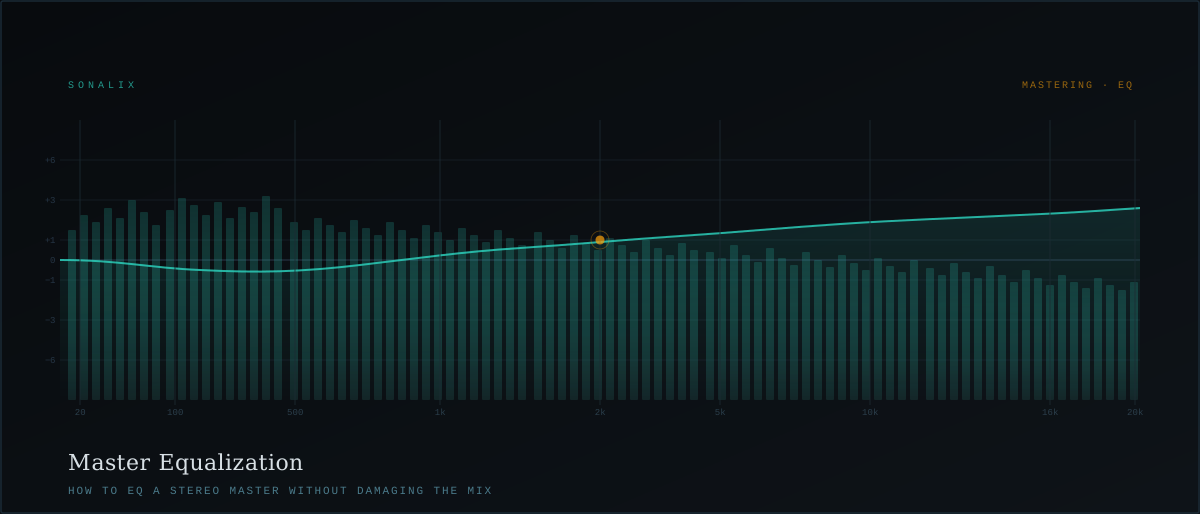
You boost 3 kHz on your master bus to bring out the vocal. Every hi-hat, snare transient, and acoustic guitar gets brighter by the same amount. The move that would have worked on a vocal channel during mixing has just created collateral damage across the entire stereo image. This is the constraint that defines master equalization, and most producers discover it only after they have made their master sound worse than the unprocessed mix.
Mastering equalization is a corrective, broadband discipline. It adjusts the tonal balance of a finished stereo mix so the frequency balance translates across playback systems. It cannot fix problems that originate in the mix, and treating it as an extension of mix EQ is the most common reason home masters degrade rather than improve.
What mastering equalization achieves and who needs it
Mastering equalization is equalization applied to a finished stereo mix. Every parameter change affects every instrument, vocal, and transient in the file simultaneously. This is the fundamental constraint: unlike mix EQ, where you can isolate individual sources on their own channels, mastering EQ operates on the combined signal. A boost at 3 kHz does not just brighten the vocal. It brightens everything that has energy at 3 kHz.
This constraint defines what mastering EQ can realistically correct. It addresses four categories of broadband tonal imbalance:
- Tonal tilt. The overall brightness or darkness of the mix relative to the intended target. A mix that sounds dull on multiple playback systems may need a gentle high-frequency shelf.
- Low-end weight. Calibrating bass content so it translates without overwhelming small speakers or disappearing on systems with limited low-frequency extension.
- High-frequency air and presence. Adding clarity or taming harshness across the mix, not on any single source.
- Genre-relative spectral balance. A hip-hop master has different low-end expectations than an acoustic folk master. The target is not a single "correct" frequency curve but a balance appropriate to the genre and its playback contexts.
If you are mastering your own tracks or evaluating masters you receive from someone else, understanding these four corrective targets tells you what mastering EQ is actually for. It is not about making the mix "better" in the way that mix EQ makes an individual track sit in the arrangement. It is about ensuring the broadband frequency balance works on headphones, car speakers, phone speakers, and studio monitors.
The four phases of mastering equalization
The mastering EQ process follows a predictable sequence: assess, reference, correct, validate. Each phase has a distinct purpose, a specific decision point, and a verifiable output. Skipping phases or reordering them is how producers end up applying EQ that compensates for their monitoring rather than correcting the mix.
Phase 1: Assess the mix on flat monitoring
Before touching any EQ, listen to the full mix on calibrated monitoring in a treated environment. The goal is to hear what the mix actually sounds like, not what your room or speakers add to it.
Listen for broadband tonal character. Does the mix sound dark overall? Bright? Is the low end heavy or thin relative to the midrange? These are the kinds of observations that mastering EQ can address. If your instinct is to point at a specific instrument ("the snare is too bright," "the bass guitar is boomy"), the problem is almost certainly in the mix, not in the master. Mastering EQ cannot surgically fix one instrument without affecting everything else in the same frequency range.
Decision point: Can you describe the tonal problem in broadband terms (the overall balance is too dark, the low end is heavy, the upper midrange is harsh)? If you are describing problems in terms of individual instruments, the fix belongs in the mix stage.
Phase 2: Reference against commercial releases
Compare your mix against commercial releases in the same genre, matched at the same playback level. Level-matching is essential: louder tracks always sound "better" in A/B comparisons because of the ear's loudness-dependent frequency sensitivity, not because of any actual tonal superiority.
Genre conventions dictate what a well-balanced master sounds like. An electronic dance track carries substantially more low-end energy than a singer-songwriter recording. Referencing within the wrong genre produces the wrong spectral target. Tools like Sonalix's 5-band energy analysis can quantify how your mix's energy distribution compares to reference material across frequency bands, giving you a measured starting point rather than relying on ear alone.
Decision point: In which specific broad frequency regions does your mix differ from the reference, and by roughly how much? If the difference is less than 2-3 dB in any broad region, your mix may not need EQ at all.
Phase 3: Apply corrective EQ moves
This is where the equalization happens. The operating principle is restraint. Mastering EQ moves should be broad and gentle: wide Q values, small gain changes. Typical mastering EQ gain changes fall in the 0.5 to 3 dB range. If you find yourself reaching for 5 or 6 dB of boost or cut, the problem is almost certainly too large for mastering to solve cleanly.
The tool you choose depends on the correction:
Linear phase EQ is the standard choice for transparent broadband correction. It applies frequency-domain gain changes without introducing the phase shift that minimum phase EQ produces. Phase shift matters more on a stereo master than on individual tracks because phase artefacts become audible across the full frequency range of the combined signal. Use linear phase EQ for gentle shelf boosts, broad tonal tilt correction, and any move where transparency is the priority.
Mid/side EQ processes the centre (mono sum) and sides (stereo difference) of the stereo signal independently. This is the one exception to the rule that mastering EQ cannot isolate elements: a vocal sitting in the centre can be brightened via mid-channel EQ without equally brightening hard-panned elements. The constraint is that everything panned centre (kick, snare, bass, vocal) is affected together.
Dynamic EQ provides frequency-dependent processing that responds to signal content rather than applying a static gain change. Where a static high shelf might tame harshness during loud sections but over-dull quiet sections, a dynamic EQ engages only when the signal in that band exceeds a threshold. This makes it valuable for problems that are level-dependent.
Analogue-modelled EQ adds harmonic colouration alongside the frequency adjustment. This is a tonal choice rather than a transparent correction. If the master needs warmth, saturation character, or the specific frequency curve behaviour of a particular hardware design, analogue-modelled EQ serves that purpose. Automatic equalization tools can handle some of these decisions algorithmically, though they work within the same broadband constraints.
Decision point: Are your gain changes staying within the 0.5-3 dB range? If any single move exceeds 3 dB, consider whether the problem is too large for mastering to address without introducing artefacts.
Phase 4: Validate across playback systems
After applying your EQ moves, check the result on multiple playback systems: studio monitors, headphones, a laptop speaker, a car stereo, a phone. A/B constantly against the unprocessed mix. The question is not whether the EQ sounds good on your primary monitors. The question is whether it improves translation.
Bypass the EQ and listen. If the processed version sounds better on your monitors but worse on headphones, the EQ move is compensating for your monitoring environment, not correcting the mix. Sonalix's frequency response curve analysis can provide an objective view of the spectral balance before and after processing, independent of your room acoustics.
Decision point: Does the EQ improve playback quality on at least two different systems? If it only improves one, the move may be monitoring-compensatory rather than corrective. Remove it and re-assess.
Diagnostic checkpoints for each phase
Each phase of the mastering EQ process has a verifiable checkpoint that tells you whether the process is on track or whether the problem should go back to the mix.
Phase 1 checkpoint (assess). Can you describe the tonal problem in broadband terms? "The mix is overall too dark" or "the low end is heavy relative to the midrange" are mastering-level observations. "The snare has too much ring at 400 Hz" is a mix-level observation. If your assessment points at individual sources, stop. The problem belongs in the mix.
Phase 2 checkpoint (reference). Does the frequency difference between your mix and the reference exceed 2-3 dB in any broad region? If the differences are smaller than that, your mix may already be well balanced. Not every master needs EQ. Applying EQ when none is needed is a form of damage.
Phase 3 checkpoint (correct). Are your gain changes within 0.5 to 3 dB? If you are exceeding that range, the problem is likely too severe for mastering to solve without introducing new problems. The appropriate response is to revisit the mix.
Phase 4 checkpoint (validate). Does the EQ improve translation on at least two different playback systems? A correction that only improves playback on your primary monitors is not a correction. It is a room compensation.
Where mastering equalization goes wrong
Five specific failure points account for most of the damage producers inflict on their masters through EQ.
Narrow surgical cuts on a stereo master. A narrow notch at 2.5 kHz to reduce vocal sibilance also cuts energy from every other element with content at that frequency: cymbals, guitars, synthesisers, room ambience. On an individual track, a surgical cut targets one source. On a stereo master, it targets the entire mix. The collateral damage is often worse than the original problem.
Over-boosting high frequencies for "brightness." A 4 dB boost on a high shelf may sound exciting on studio monitors during the mastering session. On earbuds and consumer speakers with elevated high-frequency response, the same mix becomes harsh and fatiguing within minutes. The test is not whether the boost sounds good in your studio. The test is whether it translates.
Ignoring monitoring calibration. If your monitoring environment adds a 3 dB dip at 200 Hz, you will instinctively boost 200 Hz to compensate for what your room is hiding. The resulting master will have excessive low-mid energy on every other playback system. Mastering EQ decisions are only as reliable as the monitoring chain they are based on.
Making gain changes beyond the mastering-appropriate range. Mastering EQ moves typically fall within 0.5 to 3 dB. If a mix requires 5 or 6 dB of correction in a broad region, the tonal problem is too large for mastering to fix cleanly. Forcing the correction at the mastering stage introduces phase artefacts, alters the balance between foreground and background elements, and often creates a new problem in an adjacent frequency range.
Failing to send the mix back. This is the most consequential error. When a mastering EQ move would need to be so aggressive that it introduces audible artefacts, the correct action is to return to the mix stage and address the source of the problem. A vocal that is 6 dB too bright relative to the rest of the mix cannot be fixed at mastering without darkening the entire master. A bass guitar that masks the kick drum cannot be carved out of a stereo master without removing energy from every other element in the same range. These are low-end mixing problems that require mix-stage solutions.
What is mastering equalization? Mastering equalization is corrective EQ applied to a finished stereo mix to adjust broadband tonal balance for translation across playback systems. Unlike mix EQ, which isolates individual sources on separate channels, mastering EQ affects every element in the mix simultaneously. Typical mastering EQ moves are gentle (0.5 to 3 dB, wide Q) because the stereo-master constraint means every adjustment has mix-wide consequences.
How much EQ should you apply when mastering? Typical mastering EQ gain changes fall in the 0.5 to 3 dB range. If you need more than that, the problem likely belongs in the mix stage rather than the mastering stage. Corrections beyond 3 dB on a stereo master risk introducing phase artefacts and altering the balance between elements in the mix.
Should you use linear phase EQ for mastering? Linear phase EQ avoids the phase shift of minimum phase EQ, which matters more on a stereo master than on individual tracks because phase artefacts are audible across the full combined signal. It is the standard choice for transparent broadband correction in mastering, particularly for shelf and tilt adjustments.
The outcome
If you follow the four-phase process (assess, reference, correct, validate) with discipline, you will produce a master whose frequency balance translates across headphones, car speakers, phone speakers, and studio monitors. The master will not sound dramatically different from the unprocessed mix. If it does, you have probably overcorrected.
Mastering equalization corrects broadband tonal imbalances in a finished stereo mix so the frequency balance translates across playback systems. The four-phase process (assess on flat monitoring, reference against genre-matched commercial releases, correct with gentle broadband moves of 0.5 to 3 dB, validate on multiple systems) prevents the most common mastering EQ mistakes. If the correction required exceeds what gentle broadband EQ can achieve, the problem belongs in the mix, not at mastering.