You found a plugin called "automatic double tracking" or someone told you to "put ADT on the vocal." Here is what that actually means, why it works, and whether you need it.
Automatic double tracking (ADT) is a studio technique that makes a single recorded performance sound like it was performed twice. It is a specific, well-defined process, not a vague category of widening effects, and understanding even the basics of how it works helps you use it with intention rather than treating it as a mysterious preset.
What automatic double tracking is
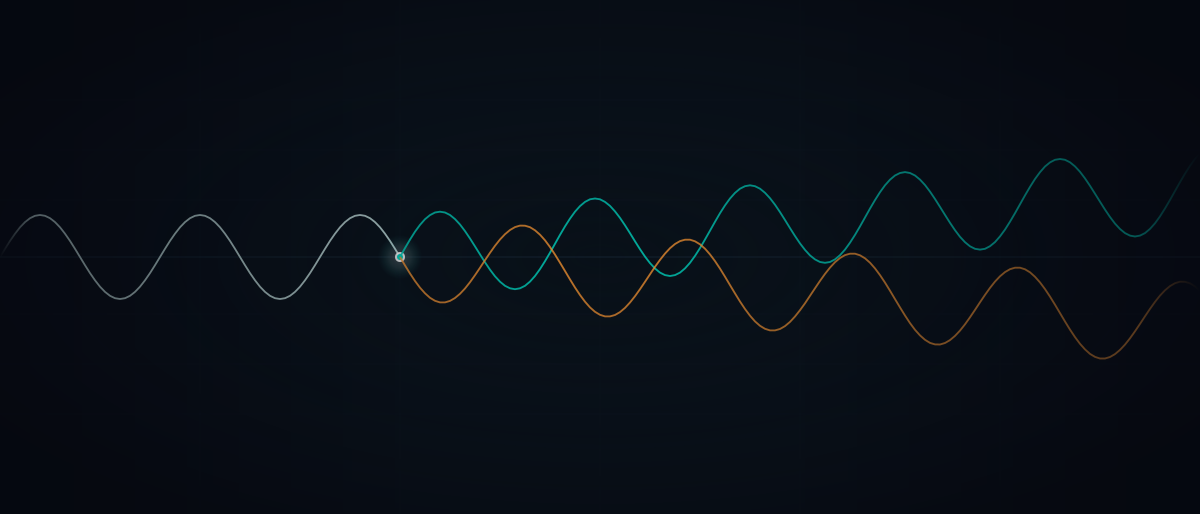
ADT duplicates a signal and applies small, continuously varying time and pitch shifts to the copy, creating what the listener perceives as a second, independent performance. The result sounds wider, thicker, and more present, as if two performers played the same part simultaneously.
The technique exists because recording the same part twice is time-consuming and requires a performer who can deliver a second take that is similar enough to sit alongside the first but varied enough to sound like two distinct performances. ADT achieves a similar perceptual result from a single recording, without requiring a second performance.
ADT is not the same as adding a simple delay to a vocal. A static delay produces an audible echo. ADT produces the impression that two people sang the same line. The difference is in the continuous, random variation of the timing and pitch, which mimics the natural inconsistency between two real human performances.
ADT vs. "artificial double tracking": are they the same thing?
Yes. Both terms refer to the same core technique. You will encounter both in plugin names, forum discussions, and tutorials, and they describe the same process.
The term "automatic" is the original Abbey Road Studios terminology: the process was called "automatic" because it automated what previously required a singer to actually perform the part again. The term "artificial" emphasises that the second performance is synthetic rather than real.
In practice, neither term implies a different technique or a different result. Some producers use "ADT" specifically for the classic tape-era method and "artificial double tracking" as a broader label for any synthetic doubling approach, but this distinction is not standardised. If a plugin or article says "automatic double tracking" or "artificial double tracking," it is describing the same thing.
How ADT actually works (simplified)
The mechanism behind ADT is straightforward, even if the implementation details vary between plugins and setups.
Step 1: the signal is copied. Your original vocal, guitar, or instrument track is duplicated. You now have two identical copies of the same performance.
Step 2: the copy is delayed by a tiny amount. The duplicate is pushed back in time by roughly 20 to 50 milliseconds. This delay is far too short to hear as an echo (you would need 50ms or more before it sounds like a distinct repetition), but it is long enough for your ear to perceive the delayed copy as a separate source rather than the same signal.
Step 3: the delay time and pitch are continuously varied. Rather than keeping the delay fixed at, say, 30ms, ADT constantly changes it by small, random amounts, and shifts the pitch slightly at the same time. This mimics the natural variation between two real human performances: when a singer performs the same line twice, the timing and pitch are never identical between takes.
The result: your brain hears what sounds like two people playing the same part, rather than one person with a processing effect applied.
That is the entire principle. The differences between ADT plugins and setups come down to how they implement these three steps, particularly how naturally they vary the timing and pitch in step 3. For the full technical breakdown of the signal chain, parameter ranges, and how to build ADT from stock DAW tools, see the complete guide to automatic double tracking.
What ADT sounds like in real recordings
The technique was invented by Ken Townsend, a technical engineer at Abbey Road Studios, in 1966. Townsend built the system because John Lennon disliked the tedious process of singing his vocal parts twice, and ADT gave the studio a way to create the doubled vocal sound from a single take.
ADT was first used extensively on The Beatles' Revolver (1966) and Sgt. Pepper's Lonely Hearts Club Band (1967). If you listen to John Lennon's vocals on these albums, you are hearing ADT: the vocal sounds wide and present, with a subtle sense of two voices rather than one, but without the shimmering quality of a chorus effect.
That said, ADT is not a vintage technique confined to 1960s recordings. It is used ubiquitously in modern pop, rock, and electronic production. Any time a vocal sounds wider and more present than a single dry recording could account for, and you do not hear two distinctly different performances, there is a good chance ADT (or a close relative) is involved. It is a standard, current production tool available in every modern DAW.
When to use ADT (and when not to)
Good candidates for ADT:
- Lead vocals that need width and presence without recording a second take
- Rhythm guitars where you want stereo spread from a single recording
- Synth pads that need spatial dimension without a built-in chorus
- Backing harmonies where stacking doubles adds thickness
Less suitable for ADT:
- Bass instruments, where the low-frequency content can become muddy and unfocused
- Transient-heavy percussion, where the delayed copy can smear the attack
- Tracks that are already doubled, where adding ADT compounds the effect into a washy, undefined sound
One honest caveat: if the performer can deliver a strong, consistent second take, manual double tracking usually sounds more natural than ADT. Real human variation is more complex than synthetic variation. ADT is not a replacement for a great second performance; it is a practical alternative when a second performance is unavailable, impractical, or unnecessary.
For a guide to specific ADT plugins and how to choose between them, see automatic double tracking plugins.
The takeaway
Automatic double tracking is not a mystery. It is a specific technique: duplicate the signal, delay the copy by 20-50ms, and vary the timing and pitch continuously. The result sounds like two performances rather than one.
ADT has been a standard studio technique since Ken Townsend built the first system at Abbey Road in 1966, and it remains one of the most useful tools for adding width and presence to vocals and instruments in any modern DAW.
Automatic double tracking (ADT) is a studio technique that makes a single recorded performance sound like it was performed twice, by creating a copy of the signal with small, constantly changing time and pitch offsets. Invented in 1966 at Abbey Road Studios, ADT is a standard production tool for adding width and presence to vocals and instruments in any modern DAW. Understanding what it does, even at a basic level, turns it from a preset you apply blindly into a technique you use deliberately.
For the full technical deep dive on ADT's signal chain, parameters, and history, see automatic double tracking: the complete guide. For the broader context of double tracking as a production technique, see double tracking.