A heavily compressed mix hits -14 LUFS integrated and passes every streaming platform's loudness target, but still feels flat, fatiguing, and lacks punch compared to reference tracks at the same perceived volume. Crest factor reveals why: the peak-to-RMS ratio has collapsed to 5 dB, indicating that transients have been crushed in pursuit of loudness.
This metric exposes compression damage that loudness measurements miss. Where LUFS tells you how loud a mix is, crest factor tells you how much dynamic headroom remains between the peaks and the average level. When that gap narrows below 8 dB, the mix has sacrificed impact for loudness.
What crest factor measures and why it matters
Crest factor is the ratio between peak and average (RMS) amplitude in a signal, expressed in dB (Source: inputs/articles/crest-factor/brief.md#Core message). It is a direct indicator of how heavily compressed a mix is. Low values reveal over-processing that destroys punch and causes listener fatigue (Source: inputs/articles/crest-factor/brief.md#Core message).
Unlike loudness metrics such as LUFS, which measure perceived volume, crest factor shows whether transients and impact have been preserved or sacrificed. A mix can hit -14 LUFS and still sound over-compressed if the crest factor has dropped too low. Crest factor reveals what loudness meters miss: whether your mix has been compressed so heavily that its punch and impact have been sacrificed for loudness (Source: inputs/articles/crest-factor/brief.md#Example positioning sentence).
Healthy commercial mixes typically land in the 8-14 dB range (Source: inputs/articles/crest-factor/brief.md#Core message). Values below this threshold indicate that transient peaks have been blunted, reducing the sense of impact and energy that makes a mix feel alive. Values above this range suggest the mix is either unmastered or intentionally preserving wide dynamics for genres that support it.
How crest factor is calculated
Crest factor is calculated by comparing the highest instantaneous peak level in a signal to its root mean square (RMS) average level. The peak measurement captures the maximum absolute sample value (Source: inputs/articles/crest-factor/brief.md#How crest factor is calculated), while RMS represents the continuous average power of the signal.
RMS is calculated as sqrt(mean(samples²)) (Source: inputs/articles/crest-factor/brief.md#How crest factor is calculated). This gives a perceptually weighted average that reflects the sustained energy of the signal, rather than just the arithmetic mean.
The crest factor formula is 20 * log10(peak / RMS) (Source: inputs/articles/crest-factor/brief.md#How crest factor is calculated), expressed in dB. A higher value indicates a larger gap between the peaks and the average level, meaning more dynamic range remains. A lower value indicates the peaks have been brought closer to the average through compression or limiting.
The measurement is performed on a mono downmix for consistency across stereo or multichannel content (Source: inputs/articles/crest-factor/brief.md#How crest factor is calculated). This ensures that crest factor readings are comparable regardless of channel configuration.
Reading the numbers: severity bands
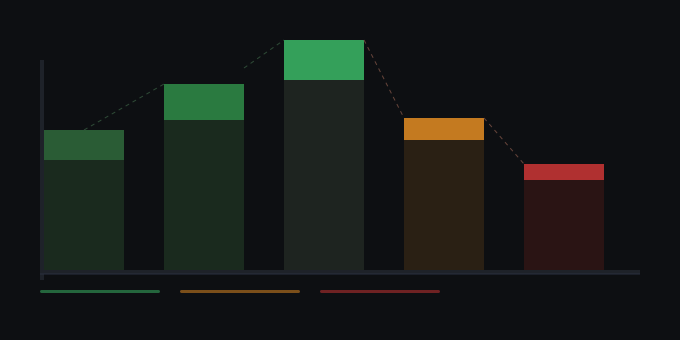
Crest factor readings fall into five severity bands that indicate how heavily a mix has been processed.
Below 4 dB (Critical): Severely over-compressed, almost no dynamic range (Source: inputs/articles/crest-factor/brief.md#Interpreting crest factor values: severity thresholds). At this level, the mix has been crushed to the point where peaks barely rise above the average level. Transients are destroyed, and the mix will sound flat, lifeless, and fatiguing. This is typically the result of extreme limiting or brick-wall compression applied without regard for dynamics.
4-8 dB (Warning): Over-compressed, transients blunted, punch reduced (Source: inputs/articles/crest-factor/brief.md#Interpreting crest factor values: severity thresholds). The mix still has some peak-to-average separation, but not enough to preserve the sense of impact. Drums and vocals will lack definition, and the mix will feel congested. This range often results from heavy mix-bus compression combined with aggressive limiting.
8-14 dB (Good): Healthy dynamics, punch preserved, transients intact (Source: inputs/articles/crest-factor/brief.md#Interpreting crest factor values: severity thresholds). This is the target zone for most commercial mixes. The mix has been compressed enough to control dynamics and meet loudness targets, but enough peak-to-average separation remains to preserve punch and energy. Transients cut through, and the mix retains its impact.
14-20 dB (Caution): High dynamic range, fine for unmastered material but may feel inconsistent (Source: inputs/articles/crest-factor/brief.md#Interpreting crest factor values: severity thresholds). This level of separation is common in mixes before mastering, or in genres like jazz and classical where wide dynamics are intentional. For commercial releases, this may feel too dynamic, with loud peaks that cause the perceived loudness to vary across streaming platforms.
Above 20 dB (Caution): Very wide dynamic range, mastering needed (Source: inputs/articles/crest-factor/brief.md#Interpreting crest factor values: severity thresholds). This is typical of unmastered stems or recordings with untamed peaks. The peaks dominate the signal, and the average level is very low. Limiting is required to bring the material into a commercial loudness range.
The 8 dB threshold is the critical boundary. Crest factor below 8 dB indicates over-compression that blunts transients and reduces impact (Source: inputs/articles/crest-factor/brief.md#Core message), even if the mix meets loudness targets.
Summary: Crest factor measures the ratio between peak and average (RMS) amplitude in a mix, expressed in dB. Healthy commercial mixes typically fall between 8-14 dB. Values below 8 dB indicate over-compression that blunts transients and reduces punch, even if the mix hits target loudness levels. Unlike loudness range (LRA), which measures variation between sections, crest factor reveals compression intensity at the processing level.
Crest factor vs loudness range (LRA)
Crest factor and loudness range (LRA) are both dynamics measurements, but they capture different aspects of a mix.
LRA measures variation between sections (verse vs chorus level differences) (Source: inputs/articles/crest-factor/brief.md#Crest factor vs. loudness range (LRA)). It tracks how much the loudness changes over time, typically across different sections of a song. A high LRA indicates the mix has sectional dynamics, with quieter verses and louder choruses. A low LRA indicates consistent loudness throughout.
Crest factor measures the instantaneous peak-to-average relationship (Source: inputs/articles/crest-factor/brief.md#Crest factor vs. loudness range (LRA)). It captures the moment-to-moment gap between the peaks and the average level within any given section. This reveals how much compression has been applied at the processing level, regardless of sectional dynamics.
A mix can have good LRA but low crest factor (heavily limited but with sectional dynamics) (Source: inputs/articles/crest-factor/brief.md#Crest factor vs. loudness range (LRA)). For example, a pop song might have a 6 LU difference between its verse and chorus (good sectional dynamics), but if both sections have been heavily compressed and limited, the crest factor in each section could still be only 6 dB (over-processed).
Crest factor is a better proxy for compression intensity at the processing level (Source: inputs/articles/crest-factor/brief.md#Crest factor vs. loudness range (LRA)). It tells you whether transients have been preserved, while LRA tells you whether the song has dynamic variation between its sections. Use both metrics together: LRA for sectional balance, crest factor for compression diagnosis (Source: inputs/articles/crest-factor/brief.md#Core message).
What your reading means for your mix
Genre context determines what constitutes a healthy crest factor reading.
Modern pop/EDM often lands at 6-10 dB (moderate to heavy limiting) (Source: inputs/articles/crest-factor/brief.md#Common scenarios and what they mean). These genres prioritise loudness and consistency, accepting some transient reduction as a trade-off for competitive volume. A reading in this range is normal for the genre, though values below 6 dB will start to sound flat.
Acoustic/jazz/classical typically measures 12-18 dB (light processing, wide dynamics) (Source: inputs/articles/crest-factor/brief.md#Common scenarios and what they mean). These genres prioritise naturalness and dynamic expression. Compression is used sparingly, and the peak-to-average separation remains wide to preserve the character of the instruments and the performance.
Below 6 dB (regardless of genre): Over-processed mixes below 6 dB feel flat despite hitting loudness targets (Source: inputs/articles/crest-factor/brief.md#Common scenarios and what they mean). The transients have been crushed to the point where the mix loses its impact and begins to sound fatiguing. Drums lack definition, vocals lose presence, and the mix feels congested.
Above 16 dB (unmastered material): Unmastered stems often exceed 16 dB (peaks untamed, needs limiting) (Source: inputs/articles/crest-factor/brief.md#Common scenarios and what they mean). This indicates the peaks have not been controlled, and the mix requires limiting before commercial release. The perceived loudness will be inconsistent across different playback systems and streaming platforms.
Genre context matters: what's normal for EDM would be over-compressed for acoustic music, and what's normal for classical would sound too dynamic for modern pop.
Fixing low crest factor
If your crest factor reading falls in the Warning (4-8 dB) or Critical (below 4 dB) bands, the following interventions will help restore transient impact.
Reduce output compression on the mix bus (Source: inputs/articles/crest-factor/brief.md#What to do if your crest factor is too low). This is the most direct intervention. If you're running a compressor on your mix bus with a ratio of 4:1 or higher, reduce the ratio or increase the threshold to allow more peak-to-average separation. Alternatively, bypass the bus compressor entirely and check whether the crest factor improves.
Raise the limiter ceiling or reduce limiter gain reduction (Source: inputs/articles/crest-factor/brief.md#What to do if your crest factor is too low). If your limiter is set to -0.1 dBFS with 6 dB of gain reduction, raise the ceiling to -0.5 dBFS or -1.0 dBFS and reduce the input gain to achieve less aggressive limiting. This allows peaks to breathe without being clipped.
Check for excessive parallel compression stacking (Source: inputs/articles/crest-factor/brief.md#What to do if your crest factor is too low). If you're running multiple compressors in parallel (for example, a drum bus compressor, a vocal compressor, and a mix bus compressor), the cumulative gain reduction across all stages can collapse the crest factor. Reduce the amount of parallel compression being blended back into the mix, or bypass one stage to test the impact.
Preserve transients: allow peaks to breathe rather than crushing them for loudness (Source: inputs/articles/crest-factor/brief.md#What to do if your crest factor is too low). Transients are what give a mix its sense of impact and energy. If you need loudness for genre expectations (EDM, modern pop), a crest factor of 6-8 dB may be an acceptable trade-off. If the genre allows dynamics (acoustic, indie, jazz), target 10-14 dB to preserve transient definition.
The decision point is whether the genre requires loudness consistency (in which case 6-8 dB may be necessary) or whether the genre supports wider dynamics (in which case 10-14 dB will sound better).
How crest factor feeds into automated analysis
Automated mix analysis systems use crest factor as one of multiple factors in quality scoring. The MixCoach.ai platform applies the following penalties based on crest factor readings.
Below 5 dB: 25-point penalty on quality tier score (Source: inputs/articles/crest-factor/brief.md#How crest factor feeds into quality scoring). This severe penalty reflects the critical over-compression threshold. A mix with crest factor below 5 dB has almost no dynamic range remaining and will sound flat and fatiguing.
Below 8 dB: 12-point penalty on quality tier score (Source: inputs/articles/crest-factor/brief.md#How crest factor feeds into quality scoring). This moderate penalty applies when crest factor falls into the Warning band, indicating over-compression that reduces punch and transient impact.
Low crest factor triggers the "dynamics" issue category in AI coaching feedback (Source: inputs/articles/crest-factor/brief.md#How crest factor feeds into quality scoring). When the system detects low crest factor, it flags the mix for dynamics-related problems and suggests corrective actions.
Suggested fixes may include: release bus compression, raise limiter ceiling (Source: inputs/articles/crest-factor/brief.md#How crest factor feeds into quality scoring). The AI coaching provides specific recommendations based on the severity of the issue, guiding engineers toward interventions that will restore transient impact without sacrificing loudness targets.
Quality scoring uses crest factor to detect compression problems that LUFS alone cannot reveal. A mix can pass loudness compliance checks and still be over-compressed. Crest factor provides the diagnostic information needed to identify and fix these issues.