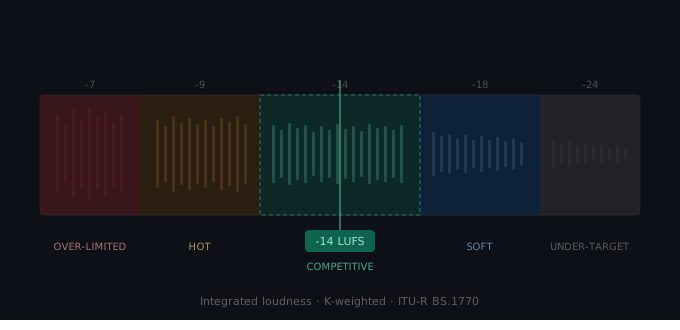
Upload a finished mix to Spotify and it will be normalised to -14 LUFS. If your track arrives at -8 LUFS, the platform does not reward you with extra perceived loudness; it attenuates you by 6 dB. The question is not how loud your mix is in your DAW. The question is where your integrated loudness lands relative to the point where the platform stops caring.
Why LUFS, not peak or RMS, determines your mix's streaming impact
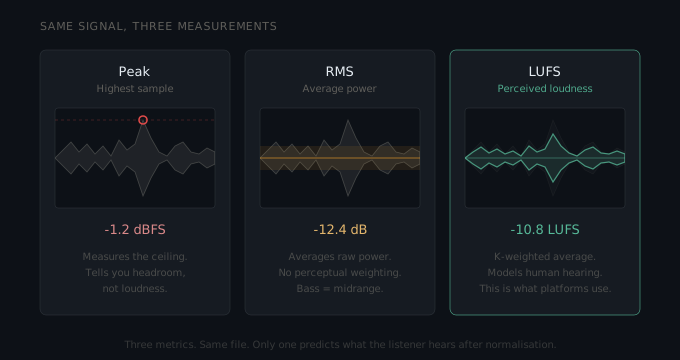
LUFS (Loudness Units relative to Full Scale) measures perceived loudness, not instantaneous signal amplitude. Rather than capturing the loudest moment in a file or averaging raw power levels, it computes a weighted average across the full track: a single number representing how loud the mix sounds to a human listener over its duration.
The weighting comes from K-weighting, a frequency filter calibrated to the human ear's sensitivity curve. Low-frequency content and extreme highs contribute less to the reading than midrange material, because that is how humans perceive loudness. The filter is defined by the ITU-R BS.1770 standard, the measurement methodology adopted by streaming platforms and broadcast standards bodies for loudness normalisation.
This makes LUFS categorically different from peak and RMS. A peak meter measures the ceiling of the signal: the highest instantaneous sample in the file. A high peak reading tells you how much headroom you have consumed, not how loud the mix sounds. RMS averages power across a window but applies no perceptual weighting, treating a sub-bass transient the same as a midrange vocal. LUFS applies K-weighting across the full track and produces a number that models human perception rather than raw amplitude.
Integrated loudness is the LUFS measurement taken over the full track or a defined analysis window. Loudness normalisation is the process by which streaming platforms gain-adjust all content to a common integrated loudness level before delivery. The normalisation target is the integrated loudness level the platform applies across every track, regardless of how it was mastered.
The consequence is direct: loudness is not a fixed property of your mix. It is a position relative to the normalisation target. A mix that sounds loud in your DAW is loud relative to silence. On a streaming platform, it is loud or soft relative to the target, and that relative position determines competitive impact.
The LUFS severity framework: from reading to decision
A LUFS reading without context is data without direction. The severity framework converts a raw integrated loudness number into a decision by routing it through four additional stages in sequence.
Stage 1: Reading. The integrated LUFS value returned by the analysis. This is the input to the framework, not the output.
Stage 2: Normalisation reference. The platform target against which the reading is evaluated. For Spotify, the normalisation target is -14 LUFS integrated. This stage transforms an absolute number into a relative position.
Stage 3: Severity label. A named category assigned based on the reading's distance from the normalisation reference. The label names the competitive condition the mix is currently in: not just a number, but a situation.
Stage 4: Practical meaning. What the severity label means for listener experience after normalisation. This is where the reading becomes actionable: not merely "hot" but "the platform will apply gain reduction before delivery, and the mix will arrive at the same perceived loudness as a reference track, with no loudness advantage gained."
Stage 5: Corrective action. The specific production decision that follows from the severity label and its practical meaning. The framework closes with a directive, not an observation.
The five stages are sequential by design. A reading without the normalisation reference is uninterpretable. A severity label without a practical meaning is a category without consequence. A meaning without a corrective action leaves the producer with a diagnosis but no treatment.
The severity zones map against the normalisation reference as follows.
Hot zone (above the target). A mix arriving above the normalisation target is attenuated by the platform. Gain reduction is applied before delivery; no loudness advantage is conferred. Mixes in this zone are typically over-limited: average loudness is high because dynamic range has been compressed and transient content reduced. Under lossy encoding, over-limited mixes carry elevated distortion risk.
Competitive range. Commercial releases typically measure -9 to -12 LUFS integrated. In this zone, a mix holds enough density after normalisation to sit alongside commercial references without triggering the attenuation applied to hotter tracks.
Soft zone (below the target). A mix below the normalisation target receives a gain boost from the platform, but the boost cannot manufacture density that was not built in at the mastering stage. A mix arriving at -18 LUFS will sound underpowered against normalised commercial content. Mixes too far below target lack the perceptual density needed to compete after normalisation.
What LUFS should my mix be for Spotify? Spotify normalises all content to -14 LUFS integrated. The competitive range for commercially mastered tracks is -9 to -12 LUFS integrated: loud enough to hold density after normalisation, not so loud that the platform's gain reduction compounds limiting artefacts under lossy encoding. A reading in that range places your mix in a position to compete perceptually with reference tracks after delivery.
Applying the framework: a mix reading -8 LUFS integrated
Take a concrete scenario: you export a completed master and upload it for analysis. Sonalix returns an integrated loudness of -8 LUFS. Here is the severity framework applied at each stage.
Stage 1 (Reading): -8 LUFS integrated.
Stage 2 (Normalisation reference): Spotify's target is -14 LUFS. This mix is 6 dB above the target.
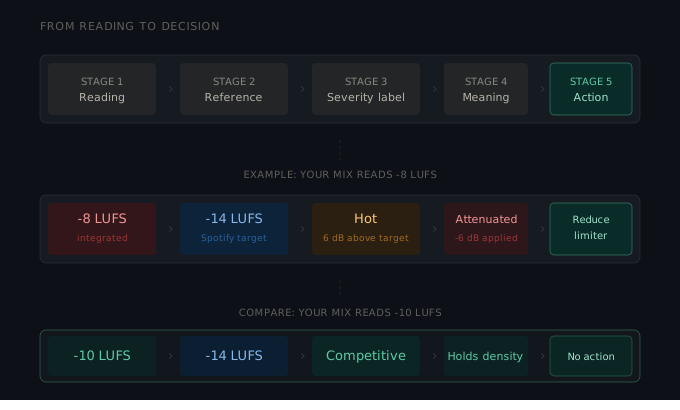
Stage 3 (Severity label): Hot / over-limited. The mix sits above the normalisation point.
Stage 4 (Practical meaning): Spotify applies 6 dB of gain reduction before delivery. The track reaches the listener at the same perceived loudness as any normalised -14 LUFS track, not louder. The loudness you pushed for in mastering does not survive delivery. What does survive is the trade-off made to get there: reduced dynamic range and higher distortion risk under lossy encoding.
Stage 5 (Corrective action): Revisit the limiter ceiling and gain staging through the master bus. Reduce the master ceiling. Recheck integrated LUFS before re-exporting. Target -9 to -12 LUFS for competitive density without triggering platform attenuation.
Why does my mix sound quiet on Spotify even though it's loud in my DAW? Because Spotify normalises to -14 LUFS. If your mix arrives at -8 LUFS, the platform applies 6 dB of gain reduction before delivery. The track reaches the listener at the same perceived loudness as any other normalised track, not louder. The loudness advantage you built in the DAW does not survive the normalisation stage.
The same five stages applied to the opposite condition: a mix returning -18 LUFS integrated. Stage 2 shows it sitting 4 dB below the normalisation target. Stage 3 labels it soft. Stage 4 identifies the practical problem: the platform lifts it by 4 dB, but a gain boost cannot manufacture density that was never built in. The mix sounds underpowered against commercial references. Stage 5 directs the producer back to the master bus: increase output density at lower threshold settings before re-exporting, not by adding more limiting.
Where integrated loudness is not enough on its own
Sonalix measures integrated loudness using the ITU-R BS.1770 standard with K-weighting applied, averaged across the whole track. The reading is a single weighted average across the measured window: precise and reproducible, but not a full dynamic picture of the track.
A reading in the competitive range does not guarantee the mix competes in every dimension. Dynamics, transient control, low-end balance, and spectral distribution are separate variables that LUFS does not capture. A mix can read -10 LUFS integrated and still be spectrally imbalanced, phase-deficient in the low end, or dynamically flat in ways that cost it clarity on consumer playback systems.
Within Sonalix, LUFS is one signal among several. It feeds into the quality score, informs verdict generation, and shapes the coaching recommendations, but the analysis does not end with the loudness reading. The LUFS result answers the normalisation question. Other metrics answer the translation question.
Does LUFS tell you everything about a mix? No. LUFS measures integrated perceived loudness and tells you where your mix sits relative to the streaming normalisation target. It does not measure dynamics, spectral balance, transient integrity, or how the mix translates across different playback systems. A reading in the competitive range is a necessary condition for competitive streaming delivery, not a sufficient one.
If your LUFS reading is in range but the mix still does not translate on playback, the problem is not loudness. Look at peak-to-average ratio, spectral balance, and low-end phase coherence.
The framework
Competitive streaming impact is not determined by how loud a mix sounds in isolation. It is determined by where its integrated loudness falls relative to the platform's normalisation target.
The severity framework is the operational layer that makes that principle actionable. It takes a LUFS reading, anchors it against the normalisation reference, assigns a severity label that names the competitive condition, derives the practical meaning for delivery, and produces a corrective action. Applied consistently to every mix, the framework converts a number into a direction.