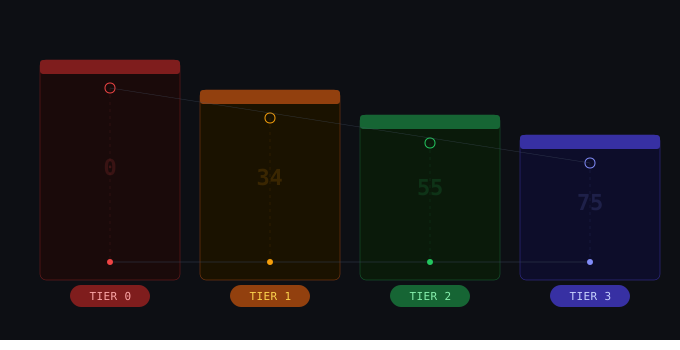
Subjective questions about mix quality lack objective answers. The Overall Quality Tier provides a measurable benchmark against commercial standards through a four-level assessment system (Source: inputs/articles/quality-tier/brief.md#Core message). This scoring mechanism translates raw technical measurements into a single composite metric that indicates commercial readiness.
What quality-tier reveals (and why it matters)
Quality-tier is a single four-level assessment displayed as a prominent badge that indicates how close a mix sits to commercial release standard (Source: inputs/articles/quality-tier/brief.md#Core message). The system starts at a baseline score of 100 and deducts points based on deviations in four measurable metrics: LUFS, True Peak, Crest Factor, and Stereo Correlation.
This transforms measurement data into actionable insight. Rather than manually interpreting whether a LUFS reading of −11 or a True Peak of −0.2 dBTP constitutes a problem, the tier provides an immediate verdict. The badge appears at the top of the results page with colour coding that signals severity at a glance: red for below standard, amber for approaching commercial quality, green for streaming competitive, and indigo for release-ready.
The tier system matters because it removes ambiguity from the assessment process. Mix decisions based on subjective opinion or partial metric readings can lead to releases that fail technical QC or sound inconsistent across playback systems. An objective scoring system based on measurable criteria establishes a shared standard between engineers, producers, and platform requirements.
How quality-tier works: technical methodology
The quality tier score is computed by the getQualityTier() function, which implements a penalty-based scoring model (Source: inputs/articles/quality-tier/brief.md#Key accuracy requirements). The function begins at 100 points and applies deductions based on four input metrics. Each metric has predefined threshold ranges, and exceeding a threshold triggers a corresponding penalty.
The four input metrics are:
- LUFS deviation from −14: The reference point for streaming loudness standards
- True Peak: Maximum sample value that prevents clipping during codec processing
- Crest Factor: Dynamic range indicator measuring the ratio between peak and RMS levels
- Stereo Correlation: Phase relationship between left and right channels
The function evaluates each metric independently, applies all applicable penalties, and returns a final score between 0 and 100. This score determines tier placement across four discrete levels. The entire calculation occurs locally without requiring external API calls, making the tier assessment deterministic and consistently available (Source: inputs/articles/quality-tier/brief.md#Page structure sections).
Two metrics that are measured but do not feed into the quality tier score are LRA (Loudness Range) and five-band spectral energy. These values inform AI coaching recommendations instead, which provide nuanced guidance about tonal balance and dynamic compression strategies. The quality tier focuses exclusively on fundamental technical compliance.
Interpreting quality-tier values and outputs
The tier system divides the 0–100 score range into four discrete levels (Source: inputs/articles/quality-tier/brief.md#Key accuracy requirements):
Tier 3 (75–100): Release-ready with minor revisions
Displayed as an indigo badge. The mix meets commercial standards with only minor adjustments needed. Any remaining penalties are small and relate to preferences rather than technical failures.
Tier 2 (55–74): Competitive for streaming
Displayed as a green badge. The mix is suitable for streaming release but has room for improvement in one or more technical areas. Penalties suggest specific measurable deviations from optimal values.
Tier 1 (35–54): Approaching commercial quality
Displayed as an amber badge. The mix has fundamental technical issues that require correction before commercial release. Multiple metrics likely exceed acceptable deviation thresholds.
Tier 0 (0–34): Below industry standard
Displayed as a red badge. The mix requires significant technical correction across multiple metrics. Penalties indicate major deviations that will cause playback issues or platform rejection.
The penalty structure for each metric reflects relative severity. LUFS deviation carries the heaviest penalties because loudness normalisation is a universal requirement across streaming platforms. The thresholds are:
- More than 8 LU deviation from −14: −40 points
- More than 5 LU deviation from −14: −25 points
- More than 3 LU deviation from −14: −12 points
True Peak penalties prevent codec clipping:
- Above −0.3 dBTP: −18 points
- Above −1.0 dBTP: −8 points
Crest Factor penalties address over-compression:
- Below 5 dB: −25 points
- Below 8 dB: −12 points
Stereo Correlation penalties catch phase issues:
- Below 0.5: −15 points
- Above 0.97: −8 points (excessive mono compatibility at the expense of width)
These values compound. A mix with loudness 10 LU off (−40 points), True Peak at −0.2 dBTP (−18 points), and Stereo Correlation at 0.3 (−15 points) results in a score of 27, placing it in Tier 0 (Source: inputs/articles/quality-tier/brief.md#Page structure).
How quality-tier integrates with other systems
The quality tier functions as the primary summary metric within a broader diagnostic framework (Source: inputs/articles/quality-tier/brief.md#Page structure sections). It appears at the top of the diagnosis summary section alongside two other outputs: per-metric severity indicators and an overall verdict in plain English.
Per-metric severity assigns individual health signals to each measured parameter. These indicators show which specific metrics triggered penalties, allowing engineers to prioritise corrections. A mix might achieve Tier 2 overall but show critical severity on Crest Factor alone, directing attention to compression settings.
Overall verdict provides a plain-English problem summary that contextualises the tier score. Where the tier quantifies technical health on a 0–100 scale, the verdict translates this into actionable language about what needs correction.
The quality tier does not trigger AI coaching but runs independently (Source: inputs/articles/quality-tier/brief.md#Page structure sections). AI coaching consumes additional data inputs including LRA and spectral band energy to generate prescriptive recommendations about EQ adjustments, compression strategies, and tonal balance. Because the tier calculation requires only the four core metrics and runs through a deterministic function, it remains available even when AI services are unavailable or fail. This architectural separation ensures that users receive baseline technical assessment regardless of external dependencies.
The tier score also establishes context for interpreting AI recommendations. A Tier 0 result with severe LUFS deviation indicates that loudness correction is the priority before addressing subtler tonal issues. AI coaching can suggest frequency-specific adjustments, but the tier score confirms whether fundamental technical requirements are met first.
Practical application and workflow
Quality tier assessment integrates into the mix workflow at the point where technical verification is required before finalising a session. This typically occurs after balancing, processing, and automation but before committing to a final master.
During mixing: Upload a bounce to generate the tier assessment. The badge provides immediate feedback about whether current processing choices meet commercial standards. If the tier is Tier 1 or Tier 0, review the per-metric penalties to identify which technical parameter needs correction. Adjust loudness, peak limiting, compression ratio, or stereo processing accordingly, then re-upload to verify improvement.
Before mastering: Confirm that the mix achieves at least Tier 2 before passing it to mastering. A mix at Tier 0 or Tier 1 requires correction at the mix stage rather than relying on mastering to fix foundational problems. The mastering engineer receives a mix that meets baseline technical requirements, allowing them to focus on final polish rather than remedial processing.
When comparing revisions: Track tier scores across multiple upload sessions to verify that adjustments improve technical health. If a revision moves from Tier 1 to Tier 2, the penalty reductions confirm that changes addressed the measured problems. If the tier remains unchanged or decreases, the adjustments either targeted the wrong parameter or introduced new issues.
Common scenario: over-compressed mix
A mix bounced with aggressive limiting might return a score of 63 (Tier 2) due to Crest Factor penalties. The per-metric breakdown shows −12 points from Crest Factor below 8 dB and −25 points from LUFS deviation over 5 LU. Reducing limiter gain by 2 dB and backing off compressor ratios on the drum bus raises Crest Factor to 9 dB and brings LUFS to −13.5 (within 3 LU of target). The revised score is 88 (Tier 3), confirming the adjustments resolved both issues.
Common scenario: phase-reversed bass
A mix with stereo bass processing returns a score of 42 (Tier 1) due to Stereo Correlation below 0.5 (−15 points). Checking bass tracks reveals inverted polarity on the sub layer. Correcting the phase relationship brings correlation to 0.78. The revised score is 85 (Tier 3), isolating the problem to a single correctable issue.
The tier system does not replace critical listening but confirms that measurable technical criteria align with commercial standards. Engineers still make creative choices about tonal balance, spatial width, and dynamic feel. The tier verifies that those choices result in a mix that will translate reliably across playback systems and meet platform technical requirements.
Summary and key takeaways
The Overall Quality Tier is a four-level assessment (0–3) displayed as a prominent badge (Source: inputs/articles/quality-tier/brief.md#Core message). The score starts at 100 and deducts points based on LUFS deviation, True Peak, Crest Factor, and Stereo Correlation. It is computed purely from measured metrics and does not require an AI API call, making it always available.
Tier 3 (75–100, indigo) indicates release-ready status with minor revisions. Tier 2 (55–74, green) signals competitive streaming quality. Tier 1 (35–54, amber) means approaching commercial standards but requires correction. Tier 0 (0–34, red) shows below-standard technical health requiring significant work across multiple metrics.
The penalty structure prioritises LUFS deviation (up to −40 points) and Crest Factor (up to −25 points), reflecting the impact of loudness and over-compression on commercial viability. True Peak and Stereo Correlation penalties prevent codec clipping and phase issues.
The tier provides objective baseline assessment independent of AI coaching, which handles nuanced tonal and dynamic guidance using additional data inputs. This separation ensures consistent availability while maintaining diagnostic depth where external services are accessible.