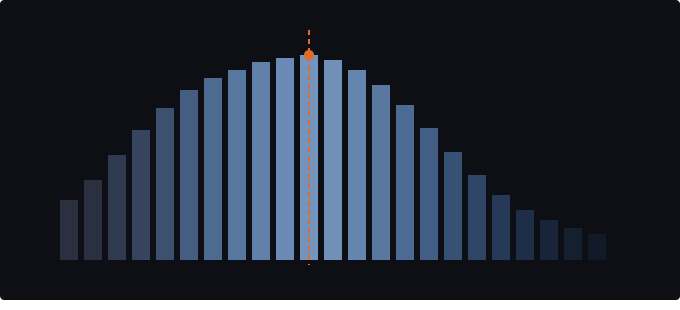
Mixes described vaguely as 'bright' or 'dark' lack objective measurement. Spectral centroid quantifies overall mix brightness as the 'center of mass' of the frequency spectrum—a single number in Hz representing where spectral energy concentrates. High values indicate energy concentrated in upper frequencies (bright mix), low values indicate energy concentrated in low end (dark or bass-heavy mix). (Source: inputs/articles/spectral-centroid/brief.md#Core message)
What spectral centroid reveals (and why it matters)
Spectral centroid is the frequency point that divides spectral energy equally into two halves. Think of it as the balance point of your mix's frequency content—the 'center of mass' where the spectrum would balance if frequency components had physical weight. (Source: inputs/articles/spectral-centroid/brief.md#Core message)
The metric addresses a fundamental problem in mix analysis. Describing a mix as 'bright' or 'warm' provides subjective impressions but no quantifiable reference. Centroid transforms this into a specific Hz value: 2500 Hz indicates balanced mid-range focus, 4000 Hz suggests high-frequency emphasis, 1200 Hz signals low-end dominance.
This matters because brightness assessment often conflicts between listeners and contexts. What sounds bright on one monitoring system may sound balanced on another. A numeric centroid reading provides consistent measurement across systems and sessions. It won't replace your ears, but it offers objective grounding for tonal decisions.
Centroid is most valuable as supporting context rather than primary diagnostic. It flags when overall brightness seems unusual given other spectral measurements, providing the AI coaching engine with additional tonal perspective. (Source: inputs/articles/spectral-centroid/brief.md#Core message)
How spectral centroid works: technical methodology
Spectral centroid calculation begins with the Short-Time Fourier Transform (STFT) magnitude spectrum computed frame-by-frame across the entire track. Each frame represents a snapshot of frequency content at a specific moment. (Source: inputs/articles/spectral-centroid/brief.md#Key accuracy requirements)
The per-frame calculation uses a weighted average formula: centroid = sum(freq * magnitude) / sum(magnitude). Each frequency bin's magnitude acts as a weight, emphasising frequencies with higher energy. Frequencies with stronger magnitude pull the centroid toward their position on the spectrum. (Source: inputs/articles/spectral-centroid/brief.md#Key accuracy requirements)
Consider a mix with substantial 100 Hz bass energy and moderate 8 kHz cymbal presence. The 100 Hz content has high magnitude, pulling the centroid lower. The 8 kHz content has lower magnitude, exerting less upward pull. The resulting centroid reflects this weighted distribution rather than simply averaging all present frequencies.
The final centroid value is the mean of all per-frame centroids across the track, reported in Hz. This temporal averaging smooths momentary fluctuations while capturing the track's overall brightness character. (Source: inputs/articles/spectral-centroid/brief.md#Key accuracy requirements)
Frame-by-frame processing ensures dynamic changes register in the final value. A track that opens dark and builds to brightness will show higher centroid than one maintaining consistent low-end focus throughout. The mean centroid captures this aggregate tendency.
Interpreting spectral centroid values and outputs
Centroid values span a wide range, with interpretation highly genre-dependent. No single 'correct' value exists—context determines whether a given centroid indicates balance or imbalance.
Below approximately 1500 Hz: Bass-heavy or dark mix with limited high-frequency content. Orchestral and classical material often occupies this range (800 to 1500 Hz), reflecting natural warmth and low-end foundation. For pop or rock productions, values this low may signal excessive bass or inadequate top-end presence. (Source: inputs/articles/spectral-centroid/brief.md#Key accuracy requirements)
1500 to 3000 Hz: Balanced range typical for most pop, rock, and electronic productions. This region suggests even distribution between low, mid, and high frequencies. Pop and rock typically settle between 2000 and 3000 Hz, while jazz and acoustic recordings often occupy 1500 to 2500 Hz. (Source: inputs/articles/spectral-centroid/brief.md#Key accuracy requirements)
Above approximately 3500 Hz: Bright mix with significant upper-mid and high energy. EDM and electronic genres may exceed 3500 Hz, reflecting intentional high-frequency emphasis and aggressive brightness. For acoustic material, values above 4000 Hz may indicate thin or brittle tonal balance. (Source: inputs/articles/spectral-centroid/brief.md#Key accuracy requirements)
Extreme values demand investigation but don't automatically indicate problems. A metal mix with substantial cymbal and distorted guitar energy may legitimately reach 4000 Hz. An ambient drone piece emphasising sub-bass and low harmonics may settle below 1000 Hz. Both reflect artistic intent rather than error.
Context matters more than absolute value. Compare centroid against genre expectations, artist references, and other spectral metrics. A 3800 Hz centroid paired with weak low-end energy in the 5-band breakdown tells a different story than the same centroid with strong bass presence.
How spectral centroid integrates with other systems
Spectral centroid functions as one input among several in comprehensive tonal assessment. It complements rather than replaces 5-band energy values and tonal balance summaries.
5-band energy breakdown provides detailed regional analysis—specific dB levels in sub-bass, bass, midrange, presence, and brilliance bands. This granularity identifies which frequency regions dominate or lack energy. Centroid condenses this multi-dimensional picture into a single brightness indicator. (Source: inputs/articles/spectral-centroid/brief.md#Page structure sections)
Tonal balance summary translates spectral analysis into plain-English assessment—'balanced', 'bass-heavy', 'bright', 'thin'. This headline gives immediate orientation. Centroid supplies the numeric underpinning that helps the AI distinguish between moderately bright (3200 Hz) and extremely bright (4500 Hz).
All three metrics feed the AI coaching engine as supporting context. The engine combines centroid with 5-band levels, tonal balance category, and dynamic range measurements to generate prescriptions. Centroid may surface explicitly when brightness departs significantly from genre norms or when 5-band energy suggests unusual high-frequency concentration. (Source: inputs/articles/spectral-centroid/brief.md#Page structure sections)
Centroid is passed to the coaching engine but does not feed into quality tier scoring or trigger hard-coded thresholds. It provides interpretive context rather than pass-fail criteria. This design prevents the system from penalising legitimate artistic choices that produce unconventional centroid values.
Practical application and workflow
Use centroid when overall brightness seems inconsistent with other measurements or listener impressions. If 5-band energy shows moderate brilliance levels but the mix sounds dull, check the centroid. A low value (below 2000 Hz) may reveal that energy clusters in lower-mids rather than upper spectrum, explaining the perceived darkness despite adequate high-frequency content by band.
Incorporate centroid into comparative analysis across mix revisions. Track how centroid shifts as you adjust EQ curves or balance levels. If adding air and presence boosts centroid from 2400 Hz to 3100 Hz, you've quantified the brightness increase. If it remains unchanged, the adjustments may affect narrow bands without altering overall spectral center.
Combine centroid with genre reference comparisons. Analyse commercial tracks in your target genre to establish typical centroid ranges. If your pop mix sits at 3800 Hz while references cluster around 2600 Hz, you have objective evidence of excessive brightness regardless of subjective listener feedback.
Centroid is least useful when interpreting isolated values without context. A reading of 2900 Hz means little without knowing the genre, comparing to other metrics, or tracking changes across revisions. Avoid treating centroid as a standalone target or quality indicator.
When brightness seems unusual given other metrics, centroid provides the supporting measurement that confirms or refutes your assessment. This is where it earns its place in the analysis suite—not as primary diagnostic, but as corroborating evidence when tonal balance questions arise.
Summary and key takeaways
Spectral centroid measures the 'center of mass' of the frequency spectrum as a single Hz value. High centroid indicates bright mixes with upper-frequency concentration; low centroid signals dark or bass-heavy tonal balance. Typical ranges span below 1500 Hz (dark), 1500 to 3000 Hz (balanced), and above 3500 Hz (bright), with genre context determining appropriate values. (Source: inputs/articles/spectral-centroid/brief.md#Key accuracy requirements)
The metric complements detailed 5-band energy analysis and tonal balance summaries rather than replacing them. Use centroid when overall brightness seems inconsistent with other measurements, when tracking tonal changes across mix revisions, or when comparing against genre references.
Spectral centroid provides supporting context for AI coaching without driving quality tier scores or hard-coded thresholds. It flags unusual brightness patterns, helping the coaching engine understand whether your mix departs from typical spectral distribution for your genre.
What is spectral centroid? Spectral centroid is the 'center of mass' of the frequency spectrum—the frequency point dividing spectral energy equally. It's calculated as a weighted average where magnitude values act as weights, reported as a single Hz value representing overall brightness.
How does spectral centroid work? Frame-by-frame STFT magnitude spectra are computed across the track. Each frame's centroid equals sum(freq * magnitude) / sum(magnitude). The final value is the mean of all per-frame centroids, capturing the track's aggregate brightness tendency.
How to interpret spectral centroid outputs? Below 1500 Hz suggests dark or bass-heavy character. 1500 to 3000 Hz indicates balanced distribution typical for pop and rock. Above 3500 Hz signals bright or aggressive high-frequency emphasis. Interpretation depends on genre expectations and artistic intent.