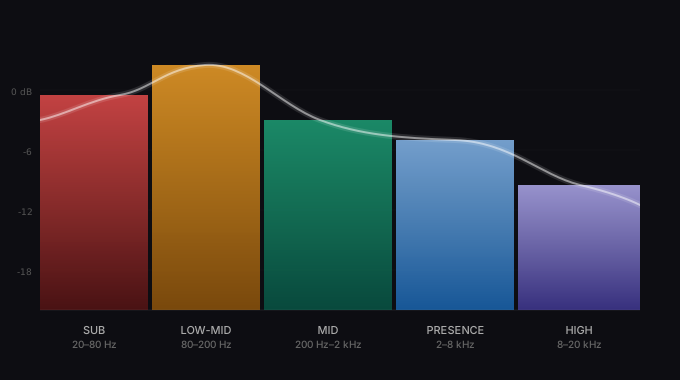
Frequency response charts and band energy values deliver precise measurements, but they require interpretation to understand what they mean for your mix. The tonal balance summary makes spectral problems immediately understandable in plain English.
The tonal balance summary is a one-headline description of your mix's overall frequency character, derived from comparing the relative energy levels between adjacent 5-band frequency regions (Source: inputs/articles/tonal-balance-summary/brief.md#Core message). Instead of interpreting charts and numeric dB values yourself, you receive a headline like "Low-mid congestion is clouding the mix" paired with a detail sentence that explains the perceptual impact on listeners. This interpretive layer connects technical data to actionable insights without requiring manual chart analysis.
What tonal-balance-summary reveals (and why it matters)
The tonal balance summary addresses a core problem in mix analysis: raw spectral data is precise but requires expertise to interpret. A frequency response chart showing elevated energy in the 200–500Hz range is technically accurate, but it does not tell you what that means for the listener's experience or what action to take.
The summary transforms this raw data into immediately understandable assessments. The interpretSpectrum() function computes band averages from the 100-point chart data, then applies a series of relative threshold comparisons to detect dominant characteristics: heavy low-end buildup, low-mid congestion, presence harshness, veiled highs, or overall balance (Source: inputs/articles/tonal-balance-summary/brief.md#Core message). The output is a single headline phrase that identifies the most significant tonal characteristic, making spectral problems instantly clear without requiring you to decode frequency charts.
This matters because it reduces the cognitive load of mix assessment. Rather than comparing five separate band energy values and mentally calculating which deviations are perceptually significant, you receive a direct statement about the mix's tonal character. The system does the interpretation work, leaving you free to focus on the creative decision of how to respond.
The summary also serves as a bridge between measurement and action. Raw numbers tell you what the spectrum contains; the summary tells you what that means and points towards which frequency regions require attention.
How tonal-balance-summary works: technical methodology
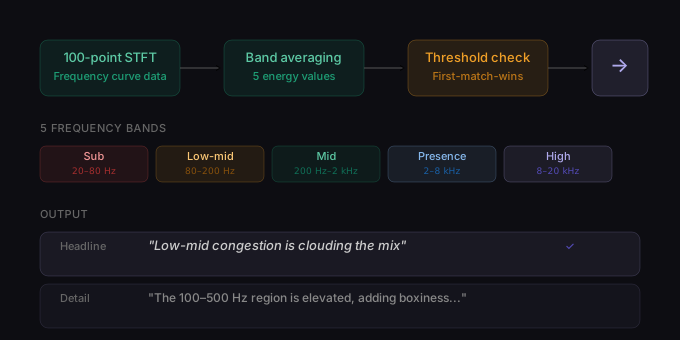
The tonal balance summary is generated by the interpretSpectrum() function running on the frontend, using the 100-point chart data as its input (Source: inputs/articles/tonal-balance-summary/brief.md#Page structure sections). The function first computes the average energy for each of the five frequency bands: sub (20–80Hz), low-mid (80–200Hz), mid (200–2kHz), presence (2–8kHz), and high (8–20kHz). These averages reduce the 100 discrete frequency points to five representative values, one per band.
Once the band averages are calculated, the function applies a sequence of relative threshold comparisons. Each comparison checks whether the energy difference between two adjacent or related bands exceeds a specific threshold measured in dB. The comparisons are designed to detect perceptually significant tonal imbalances: conditions where one frequency region dominates or recedes enough to affect the listener's experience (Source: inputs/articles/tonal-balance-summary/brief.md#Key accuracy requirements).
The function uses first-match-wins logic: the conditions are checked in priority order, and the first condition that evaluates to true produces the headline (Source: inputs/articles/tonal-balance-summary/brief.md#Page structure sections). This ensures clean, unambiguous output. Rather than generating multiple overlapping assessments, the system identifies the single most significant tonal characteristic and presents that as the summary. If none of the threshold conditions are met, the function returns "Overall tonal balance is controlled", indicating that no perceptually dominant frequency region was detected.
The entire computation runs on the client side, deriving the summary from the same spectral data that powers the 5-band energy metrics and the full frequency curve. This means the summary, the numeric band values, and the detailed chart are all consistent views of the same underlying STFT analysis (Source: inputs/articles/tonal-balance-summary/brief.md#Page structure sections).
Interpreting tonal-balance-summary values and outputs
The tonal balance summary uses seven distinct conditions, each mapped to a specific headline phrase. The conditions are checked in priority order, with the first match determining the output (Source: inputs/articles/tonal-balance-summary/brief.md#Page structure sections).
The condition-to-headline mapping is as follows:
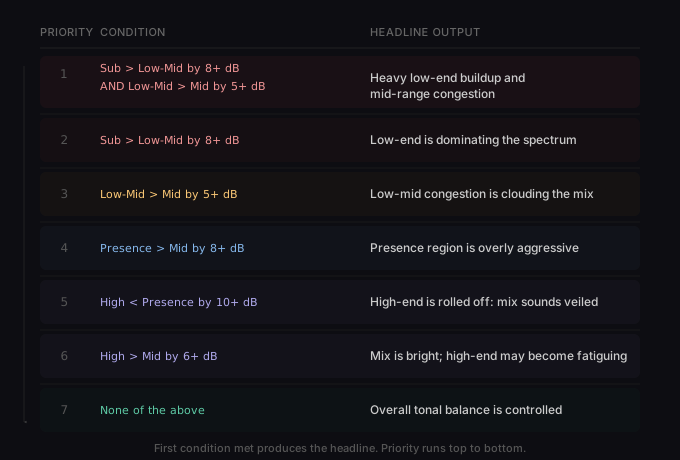
These thresholds reflect perceptually significant differences. A sub-bass region that exceeds low-mid energy by 8dB or more indicates substantial low-frequency dominance that will likely produce a boomy or overpowering low end. A low-mid region elevated 5dB or more above the midrange signals the kind of buildup that produces muddiness and masks vocal clarity.
Each headline is paired with a detail sentence that explains the perceptual impact on listeners (Source: inputs/articles/tonal-balance-summary/brief.md#Page structure sections). For example, the "Low-mid congestion is clouding the mix" headline is accompanied by: "The 100–500Hz region is elevated, adding boxiness and muddiness. Clarity and definition in the vocals and instruments will suffer." This detail sentence connects the technical finding to the subjective listening experience, making the assessment relatable and actionable.
The first-match-wins prioritization means that the most severe or most common problems are detected first. If your mix exhibits both low-end buildup and high-end brightness, the system will identify the low-end issue as the primary concern, since the conditions for low-end dominance appear earlier in the priority sequence. This prevents ambiguous or conflicting output and ensures you receive a single, clear assessment to act on.
How tonal-balance-summary integrates with other systems
The tonal balance summary is displayed on the analysis results page in a dedicated summary card, separate from the individual metric cards (Source: inputs/articles/tonal-balance-summary/brief.md#Page structure sections). This placement positions the summary as a contextual bridge between the numeric measurements and the prescription section. You see the headline and detail sentence before encountering the specific fixes, giving you an interpretive frame for understanding which frequency regions require attention.
The summary also feeds into the AI coaching engine as part of the tonal assessment context (Source: inputs/articles/tonal-balance-summary/brief.md#Page structure sections). The raw measurements—both the 5-band energy values and the plain-English summary headline—are passed to the AI system, which uses them to inform priority fix selection and contextual explanations. This allows the AI to reference the tonal character in natural language when suggesting EQ adjustments or frequency-specific processing.
The relationship between the three tonal representations is complementary. The 5-band energy values provide numeric dB readings for each frequency region, offering precision and detail. The tonal balance summary interprets those values, translating relative differences into a plain-English assessment. The full frequency curve presents the complete 100-point spectral data for manual inspection. All three are derived from the same STFT analysis, ensuring consistency across different views of the tonal landscape (Source: inputs/articles/tonal-balance-summary/brief.md#Page structure sections).
This integration means the summary functions as both a standalone assessment and a supporting element in the broader analysis system. It can be read independently for a quick tonal orientation, or it can be cross-referenced with the numeric band values and detailed frequency curve for deeper investigation.
Practical application and workflow
The tonal balance summary is most useful as a first-pass orientation tool. When you load analysis results, the summary tells you immediately whether your mix has a dominant tonal characteristic that requires attention. This allows you to quickly identify the primary frequency issue before examining individual metrics or diving into detailed spectral data.
In practice, the summary output points towards specific workflow actions. If you receive "Low-end is dominating the spectrum", check for sub buildup in kick and bass instruments and apply high-pass filtering to non-bass elements (Source: inputs/articles/tonal-balance-summary/brief.md#Page structure sections). If the summary reads "Low-mid congestion is clouding the mix", address the 200–500Hz range by reducing buildup in guitars, snares, or low vocals, and check for masking issues between competing elements in that region.
A "Presence region is overly aggressive" headline indicates harshness in the 4–8kHz range, typically requiring reduction in vocal sibilance or cymbal brightness (Source: inputs/articles/tonal-balance-summary/brief.md#Page structure sections). "High-end is rolled off: mix sounds veiled" suggests the need to add air above 10kHz, either through shelving EQ or by revisiting high-frequency processing that may have been too aggressive. "Mix is bright; high-end may become fatiguing" signals potential listener fatigue and suggests monitoring high-end levels or applying subtle high-frequency reduction (Source: inputs/articles/tonal-balance-summary/brief.md#Page structure sections).
If the summary returns "Overall tonal balance is controlled", this indicates that no perceptually dominant frequency region was detected (Source: inputs/articles/tonal-balance-summary/brief.md#Page structure sections). This does not mean the mix is perfect—it means the broad tonal balance is within acceptable limits, and you can proceed to assess other aspects such as dynamic range, stereo width, or individual metric performance.
The summary is based on five broad frequency bands, which means it will not detect narrowband issues like resonant peaks at specific frequencies or problems occurring between band boundaries (Source: inputs/articles/tonal-balance-summary/brief.md#Page structure sections). For detailed frequency analysis, use the full frequency curve. The summary provides high-level orientation, not granular diagnosis.
What is tonal-balance-summary? The tonal balance summary is a plain-English description of a mix's overall frequency character, generated from comparing relative energy levels across five frequency bands. It provides an immediately understandable assessment of spectral balance without requiring manual chart interpretation.
How does tonal-balance-summary work?
The interpretSpectrum() function computes average energy for five frequency bands from 100-point chart data, then applies a sequence of relative threshold comparisons. The first condition that exceeds its threshold produces a headline phrase paired with a detail sentence explaining the perceptual impact.
How to interpret tonal-balance-summary outputs? Each headline corresponds to a specific tonal condition detected by threshold comparisons between frequency bands. The detail sentence explains what the condition means for listener experience. Use the headline to identify which frequency region requires attention, then consult the 5-band energy values or full frequency curve for detailed analysis.
Summary and key takeaways
The Tonal Balance Summary is a plain-English description of frequency character derived from 5-band energy comparisons. The interpretSpectrum() function applies relative threshold comparisons with first-match-wins logic to generate headlines like "Low-mid congestion is clouding the mix", bridging raw spectral data and actionable insight without requiring users to interpret charts (Source: inputs/articles/tonal-balance-summary/brief.md#Core message).
The system uses seven condition checks with specific dB thresholds to detect perceptually significant tonal imbalances (Source: inputs/articles/tonal-balance-summary/brief.md#Page structure sections). Each headline is paired with a detail sentence explaining the impact on listener experience. The summary is displayed in a dedicated card on the analysis results page and feeds into the AI coaching engine as tonal context.
The summary provides high-level orientation based on five broad frequency bands. It will not detect narrowband resonances or problems between band boundaries. For detailed frequency analysis, use the full frequency curve alongside the summary for a complete tonal assessment.